
This blog post will focus on Framestore, a London-based VFX company. Framestore’s main production areas include film, advertising, and games. In my understanding, VFX largely involves CGI and 3D animation, and based on my research, VFX jobs are divided into three phases: pre-production, mid-production, and post-production. Pre-production roles include concept design, scene design, and character design. Mid-production focuses more on animation, modeling, and special effects. Post-production is more about finishing touches, such as rendering, compositing, and final output. In my opinion, VFX is a technology that brings virtual ideas and unrealistic visions to life, and it’s a very important part of the film and television industry today.
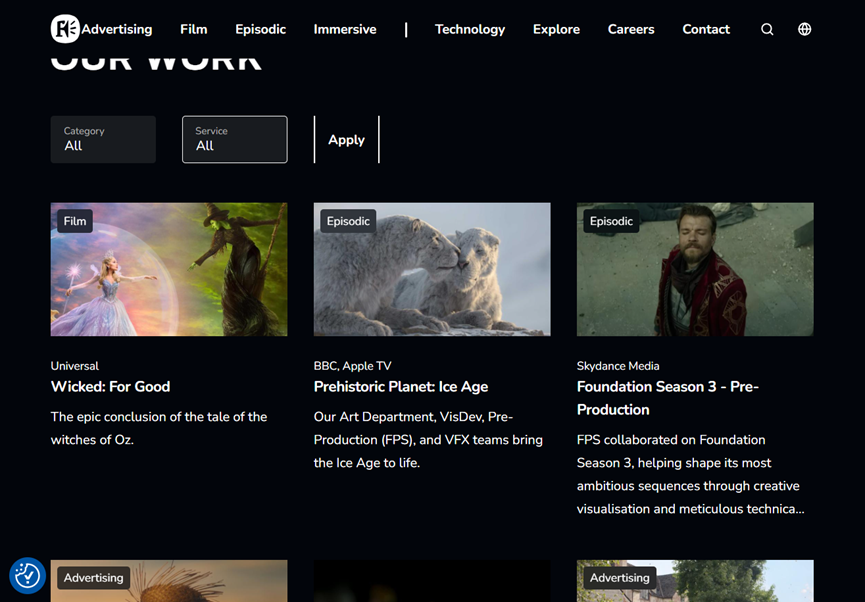
(Screenshot from the official Framestore website)
Returning to Framestore, many of their VFX works are very famous, such as their work on Universal’s Wicked: For Good, EA’s Battlefield 6, and Netflix’s One Piece series.
Among Framestore’s many art positions, I particularly favor the pre-production concept artist role. As concept artists at Framestore, their work focuses on helping projects create a clear direction, such as designing characters with distinct personalities and defining the style and purpose of scenes. To ensure the accuracy of the creative direction, concept artists need to collect existing film footage, artistic arrangements, etc., from the internet. It’s worth mentioning that as early-stage concept artists, they don’t need to be overly concerned about copyright issues, as all art work is done within the company environment. This means that some illustrations and designs by concept artists can be presented in a collage format (as long as the meaning is accurately conveyed).
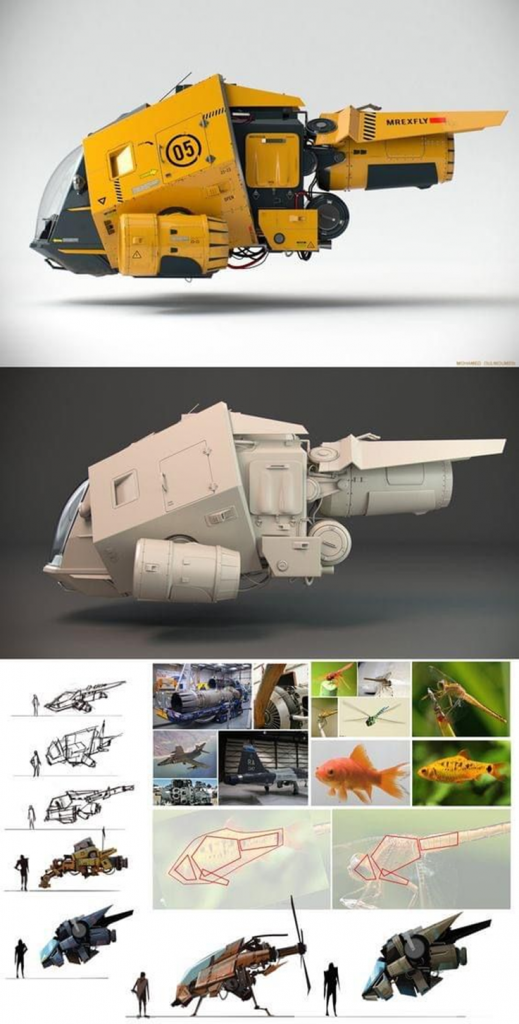
(Artwork by artist “Zebraa .” on Behance.)
After establishing a general direction, the initial concept draft stage begins. Concept artists need to draw more precise sketches and details of products such as costumes and props. These artistic outputs are all submitted to the Art Director or Supervisor for review and further revisions based on feedback. In the subsequent refinement stage, concept artists also need to use some 3D software to create simple models to provide more accurate references for the subsequent modeling team. After all the above work is completed, their artistic output participates in daily reviews for continuous optimization until the most satisfactory result is achieved.
In general, Framestore’s concept artists collaborate with other art departments within the company using their own creative ideas to ensure that the designs can be brought to life.
Leave a Reply